
History of Singapore
The History of Singapore: From Origins to Modern Day
Journey through Singapore’s transformation from a small fishing village to a global powerhouse. Discover how this tiny island nation at the crossroads of East and West evolved through colonial rule, wartime occupation, independence struggles, and economic miracle to become one of the world’s most dynamic cities.
Early Beginnings and Strategic Location
Ancient Maritime Hub
Long before colonial powers arrived, Singapore functioned as a vital trading outpost since the 14th century. Archaeological evidence reveals trade connections spanning from China to India, with ceramics and artifacts demonstrating extensive maritime commerce.
Strategic Position
Situated at the southern tip of the Malay Peninsula along the crucial Malacca Strait, Singapore controlled access to key shipping routes connecting the Indian Ocean to the South China Sea. This natural deep-water harbor became a coveted position for regional powers.
Early Names
Historical records first referred to the island as "Temasek" (Sea Town), while later Javanese chronicles called it "Singapura" (Lion City) after a Sumatran prince reportedly spotted a lion on the island—though lions never naturally inhabited Singapore.
Add Your Heading Text Here
Explore Singapore's History
Founding by
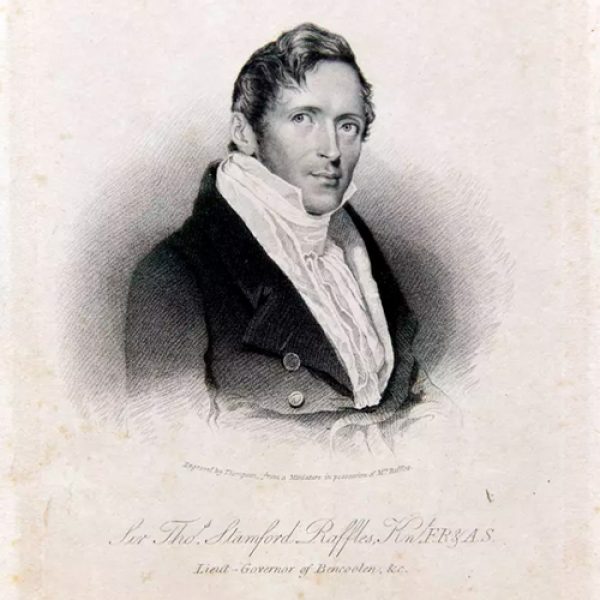
Sir Stamford Raffles (1819)
Sir Stamford Raffles arrives in Singapore aboard the Indiana, seeking a strategic trading post for the British East India Company.
Raffles signs a treaty with Temenggong Abdul Rahman and Sultan Hussein Shah of Johor, securing rights to establish a trading post.
Raffles implements the Raffles Town Plan, organizing Singapore into ethnic districts with a European town center.
The Anglo-Dutch Treaty firmly establishes British control over Singapore, with the Dutch recognizing British claims to the island.
Rise as a British Colony
(1826-1867)
In 1826, Singapore was incorporated into the Straits Settlements alongside Malacca and Penang, initially administered by the British East India Company from Calcutta. By 1867, growing importance led to direct British crown colony status, reporting to London rather than India.
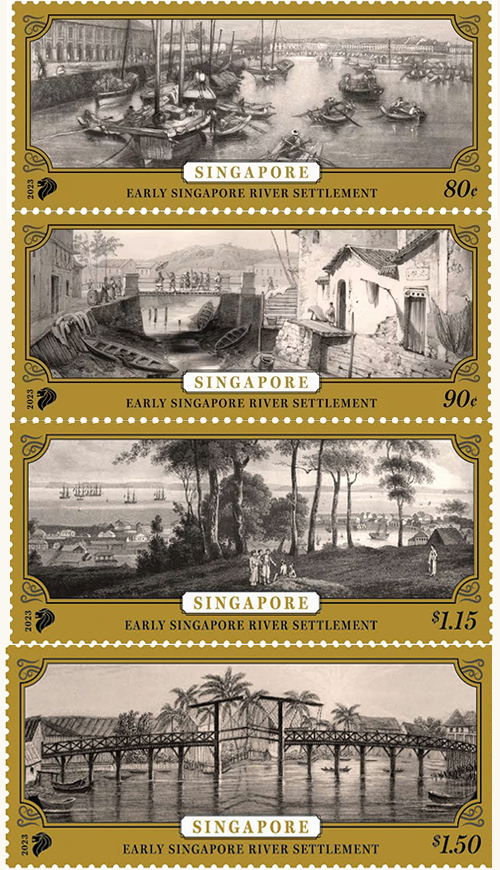
The island rapidly grew as a free port, drawing merchants from across Asia, the Middle East, and Europe. Trade in tin, rubber, spices, and opium flourished, with warehouses and processing facilities lining the Singapore River. Annual trade value soared from $400,000 in 1819 to over $13 million by 1850.
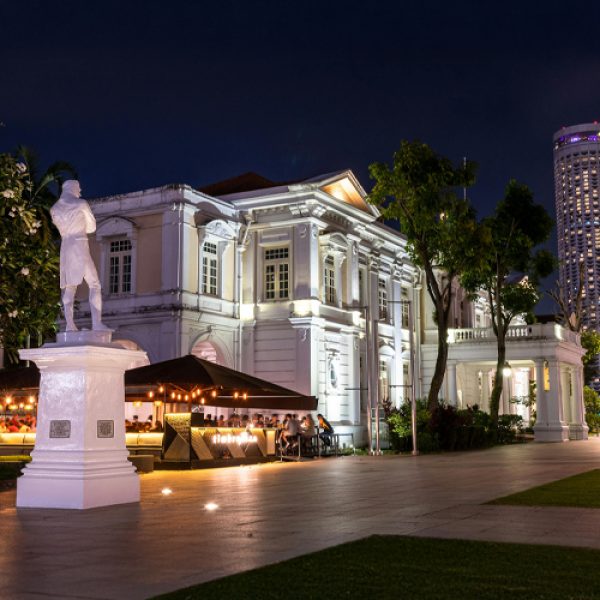
Colonial authorities established essential infrastructure including roads, bridges, and government buildings. The iconic Raffles Hotel opened in 1887, while key administrative buildings like the Supreme Court and City Hall (now National Gallery) showcased the growing prosperity.
Urbanization and Demographic Change
Late 1800s
The largest immigrant group, Chinese workers arrived primarily from southern provinces like Fujian and Guangdong. They dominated trades including construction, agriculture, and commerce, establishing dialect-based clan associations that provided social support.
Indians came as laborers, traders, and civil servants, with distinct Tamil, Malayalee, and Sikh populations. They contributed significantly to infrastructure projects and established vibrant commercial networks throughout Southeast Asia.
Indigenous Malays maintained cultural traditions while adapting to colonial rule. Many worked as fishermen or in administrative roles, preserving cultural institutions like the Kampong Glam royal enclave around the Sultan’s residence.
The growing population drove housing innovations like shophouses—multi-purpose buildings combining ground-floor businesses with upstairs residences. Distinct ethnic enclaves formed what would become Chinatown, Little India, and Kampong Glam.
Economic Importance and
Suez Canal Effect (1869+)
Suez Canal Opens (1869)
Asia, eliminating the need to circumnavigate Africa.
Shipping Boom
Maritime traffic through Singapore increased exponentially as steam-powered vessels could now make the journey from London to Singapore in just 30 days instead of 90.
Infrastructure Expansion
Massive investment in port facilities, warehouses,
and commercial infrastructure transformed Singapore’s waterfront to accommodate growing trade volumes.
Economic Transformation
Singapore became one of the British Empire’s most valuable trading hubs, handling a vast volume of rubber, tin, spices, and other commodities.
World War II and Japanese Occupation (1942-1945)
Fall of Singapore
On February 15, 1942, British Lieutenant-General Arthur Percival surrendered Singapore to Japanese forces led by General Tomoyuki Yamashita, following a swift 70-day campaign down the Malay Peninsula. This devastating defeat, with the surrender of 80,000 troops, was described by Winston Churchill as the “worst disaster” in British military history.
Syonan-To Period
The Japanese renamed Singapore “Syonan-To” (Light of the South) and imposed harsh military rule. Citizens faced food shortages, strict rationing, and the constant fear of kempeitai (military police) brutality. The Japanese dollar became the official currency, and public clocks were adjusted to Tokyo time.
Operation Sook Ching
In February 1942, the Japanese conducted a purge of perceived anti-Japanese elements, primarily targeting Chinese males. Thousands were rounded up at screening centers, with many never returning. Estimates of those killed range from Japanese figures of 5,000 to local claims of 50,000.
Liberation
Following Japan’s surrender on September 2, 1945, British forces returned to Singapore. Operation Tiderace reestablished British Military Administration on September 12, ending three years and seven months of Japanese occupation that permanently changed Singaporeans’ perception of colonial rule.
Return to British Rule and
Political Awakening (1945-1959)
British Return
When British forces returned in September 1945, they faced the monumental task of rebuilding a devastated colony. The Japanese occupation had shattered the myth of British invincibility and awakened political consciousness among Singaporeans who now questioned the legitimacy of colonial rule.
Labor Movement
The post-war period saw the rapid growth of trade unions and labor activism. Major strikes in the late 1940s and early 1950s reflected growing dissatisfaction with economic conditions and colonial policies, creating fertile ground for political mobilization.
Political Parties Emerge
New political parties formed to channel nationalist sentiments, with the People’s Action Party (founded in 1954) becoming the most significant. Led by a young lawyer named Lee Kuan Yew, the PAP built a broad coalition of English-educated professionals, Chinese-educated activists, and labor unions.
Towards Self-Government (1950s)
Add Your Heading Text Here
Full Internal Self-Government (1959)
First general election with universal suffrage; PAP wins 43 of 51 seats.
Constitutional Talks (1957-1958)
self-government.
Legislative Assembly (1955)
First election with limited self-government; Labour Front forms government.
Rendel Constitution (1953)
self-rule.
The 1950s marked Singapore’s crucial transition toward self-determination. After the Rendel Commission’s recommendations increased local participation in governance, the 1955 elections established a partially elected Legislative Assembly. Though the Labour Front initially formed the government under David Marshall, his resignation after failed constitutional talks paved the way for Lim Yew Hock’s administration.
By 1959, after successful negotiations with Britain, Singapore achieved full internal self-government. The landmark May 1959 general election resulted in a decisive victory for the People’s Action Party, with Lee Kuan Yew becoming Singapore’s first Prime Minister at just 35 years old. This period laid the groundwork for Singapore’s emerging national identity and political system.
Merger with Malaysia (1963)
Political Motivations
For Singapore, merger offered economic benefits and security against communist influence. For Malaya, incorporating Singapore prevented it from potentially becoming a communist Chinese state on its border.
Malaysia Agreement
Signed on July 9, 1963, creating a federation of Malaya, Singapore, Sarawak, and North Borneo (Sabah). Singapore maintained some autonomy in education and labor policies.
Emerging Tensions
Fundamental disagreements quickly surfaced over economic policies, Singapore’s autonomy, and the treatment of the Chinese population. The UMNO-led federal government and Singapore’s PAP became increasingly at odds.
Malaysia Day
On September 16, 1963, the Federation of Malaysia was officially formed, with Singapore as a state rather than an independent entity.
Separation and
Independence (1965)
On August 9, 1965, Singapore was unexpectedly expelled from the Federation of Malaysia. After months of escalating tensions between Singapore’s People’s Action Party and Malaysia’s ruling alliance, Malaysian Prime Minister Tunku Abdul Rahman made the fateful decision that separation was the only solution to prevent potential communal violence and political deadlock.
In a televised press conference that same day, an emotional Lee Kuan Yew announced: “For me, it is a moment of anguish. All my life, my whole adult life, I have believed in merger and unity of the two territories.” Despite the traumatic separation, Singapore’s leadership quickly mobilized to address the existential challenges of unexpected independence. Yusof bin Ishak became the first President of the Republic of Singapore, while Lee Kuan Yew continued as Prime Minister, now facing the daunting task of building a viable nation from a small island with no natural resources.